Ads used to be here |
 |
 |
 |
 |
 |
 |
 |
 |
|
Philip Kan Gotanda Revealed Philip Kan Gotanda journeys to the late 60�s for The Wind Cries Mary by Lia Chang |
||||
|
||||
Gotanda�s
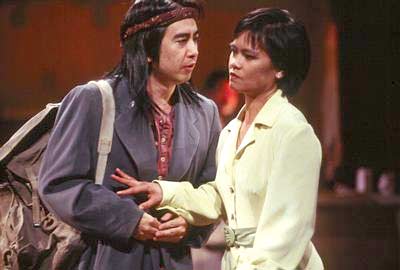
latest, is The Wind Cries Mary, a play he has loosely based
on Ibsen�s Hedda Gabler. In November 2002, the cast set the
San Jose Repertory�s stage ablaze with fireworks. The action
in Gotanda�s provocative drama takes place in San Francisco,
circa 1968. While
the 60�s was an era of rock �n� roll, Vietnam and the Civil Rights
movement it was also a defining era when Japanese, Chinese, Filipino
and Korean American students on campuses throughout California were
finding their political voice. Asian
American students were seeking equal entitlement and representation
alongside the protests against American involvement in Vietnam.
They discovered themselves amidst America�s changing consciousness
of identity and were grappling with the notion of being �Oriental�
vs �Asian American.� Tackling
Ibsen�s timeless themes of power, racial identity and gender politics
in The Wind Cries Mary, Hedda Gabler becomes Gotanda�s Eiko
Hanabi, a Japanese American woman of volatile proportions. Searching
for her Asian American identity, Eiko is a person out of time trapped
between a world of tradition and a new state of being, desperately
struggling to break free.� The Wind Cries Mary featured Gotanda
regulars Stan Egi and Sab Shimono with Tess Lina, Allison Sie, Thomas
Vincent Kelly, and Joy Carlin under the direction of Eric Simonson.
Gotanda reveals his creative process in
shaping The Wind Cries Mary in an interview with AsianConnections�
Lia Chang during a rehearsal break. Lia: What motivated
you to tackle this particular subject now?
Philip: Timothy Near,
the artistic director of San Jose Rep suggested it. I made it very
clear that I can�t tell what I�m going to write.�
I can point in a certain direction but I can never tell what�s
going to happen.� The initial
topic that we thought was doable was CEO�s in Silicon Valley. I
interviewed some extremely wealthy men in their early 40�s. I didn�t
find their lives all that remarkable.� So I bailed on that.� Timothy suggested I consider Hedda Gabler.� My initial reaction was, �Not another adaptation
of Hedda Gabler.�� That
was playing on Broadway at the time.� I went back and reread the play and was quite moved. I found it
extremely compelling. I read it again and again.� I realized this female protagonist is one of the most interesting
ones I�ve even encountered. I thought in terms of the late 60�s,
a time era I�d always been interested in and wanted to do a play
about.� In particular about someone who was caught
on the cusp of the changing consciousness of America, having to
do with identity politics.� My
Eiko is someone who had invested in being an �Oriental American.�
And she�s been good at it.� Then
she finds herself amidst this turmoil in which there is a new consciousness
that�s emerging.� In which she looks at and knows that there
are truths there, but also that�s she�s not sure whether she�s capable
of facing them, wanting to or even can as she is so much vested
in this old way of thinking. That topic fit really well into the
plot structure of Hedda Gabler.�
Philip:
The
very fact that �Asian Americans� is such a mainstream term now.
Prior to the mid sixties it was non-existent.�
It gives us some indication to the journey we�ve traveled.
At the same time it seems to be of so much of what Eiko goes through.
Her struggle would still be applicable in 2002. Lia:
What are some of the major achievements that women�s rights groups
and civil rights groups accomplished during this time? Philip: There were new
ways of looking at issues. Along with the ideas, people were putting
their bodies on the line. It wasn�t just intellectual thoughts.� Ideas and thoughts were coupled with action.
And sacrificing. That is what changed everything. Eiko struggles
with the idea that she�s not sure if she makes this jump into the
void of liberation, if there is even an intellectual model for her
to grasp onto. For a woman, you take this leap, you change your
life and the new model hasn�t emerged yet.� At the time, Ms. Magazine had yet to come out.�
A lot of the terminology had yet to take shape, or rather
this idea of how involved they were in the �movement.� In my play
Eiko feels that even though this movement is supposed to be progressive,
sometimes those in the �movement� are still serving coffee. She
is cynical about what�s going on. Lia:
What social conditions and principles are at work in 1968? What
is their impact on Eiko? Philip: Eiko understands
that Asian Americans are beginning to look at a bigger picture rather
than their small little community. America, activities of a nation,
why they fight war and why they go to war- there�s a whole bigger
world out there related to the politics of who and what they are
in the politics of America. Their vision of the world is expanding.
It�s beginning to intrude on their small quiet life. Lia:
Your title The Wind Cries Mary is a Jimmy Hendrix song. How
important is music to this play? Philip:
Jimmy
Hendrix is a specific choice. He was a very interesting artist.� He was the first �black artist to play rock
and roll� and to be recognized as an icon.�
That fit with the play in terms of being caught on the cusp
of cultures of being pushed and pulled. Hendrix had to go to England
to become popular and then come back.�
I�ve always been interested in his music; it makes sense
that I would use his music in this play.�
That deals with being caught on the cusp of our change in
national consciousness into racial identity politics. �The Wind Cries Mary was not the original
title.� There was no title
for the play.� As I wrote
the play, the name Mary came up, and became part of the play.�
And then I thought at some point The Wind Cries Mary
would be a nice title for the play.�
It has a melancholic feel to it. The song does too.�
That�s how it became the title and that�s why I use his music. Gotanda�s plays include family dramas The Wash and
Sisters Matsumoto, the surrealistic Fish Head Soup
and punk rock pop-fantastic Dream of Kitamura, the
biting social commentary Yankee Dawg You Die, floating
weeds, Yohen, and the ethereal, romantic The Ballad of Yachiyo which all resonate with the stylish stamp of his uniquely
Asian American vision. Several years ago the San
Francisco-based playwright segued into making independent films-his
short films-Drinking Tea and The Kiss.�
His debut feature Life Tastes Good screened at
the Sundance Film Festival and most recently at the Dublin
Film Festival. A
Guggenheim fellow, he is a recipient of three awards from the National
Endowment for the Arts (NEA) and a TCG-PEW National Theater Arts
Award. While his plays have been presented at every major Asian
American Theater in the nation, as well as the Mark Taper Forum,
Manhattan Theater Club, and New York Shakespeare
Festival, last year he made his mark internationally with The
Ballad of Yachiyo at London�s Gate Theatre in co-production
with the Royal National Theatre.�
Next season, the Maple Leaf Theatre in Tokyo will feature
a new Japanese language translation of Nisei Fisherman. Lia:
In addition to The Wind Cries Mary, which just completed
it�s run in November 2002; your plays are now being produced on
international stages. How exciting to have your work produced at
the Gate Theater in London. Had you been there before? Philip: First time
I actually went with a production. London is the Theatre town. I
enjoyed it because of the nice theater aesthetic. It�s like New
York- people are conversing about theatre.�
I met the artistic director at the Royal Court.�
I was introduced to a lot of new writers, which I really
enjoyed.�
Lia: How did
the Maple Leaf Theatre in Japan become interested in your work?
Philip: My plays are
getting translated into Japanese; this is a translation of one of
my early works Nisei Fisherman. I tried for the longest time
to get my work over there and to be honest; they haven�t been interested
in my work specifically because of the Japanese American themes.�
A country like Japan is not as interested in Japanese Americans
as they are in white or black Americans.�
That�s been changing in the last couple of years. Young folk
are going out into the world and the world is intruding on Japan.
The Japanese in Japan are more aware of the American and Asian American
constituency. The consequence is that things are changing and some
of the theatres are interested in my work.� It is a beginning. Lia: You lived
in Japan for a time. What was that like? At what point in your career
did you live there?
Philip:
I did it in my early twenties. A great experience. It's interesting
to go to where your grandparents came from. And if you really want
to know what it's like to be an American, live abroad. It allows
you to look at yourself, your world, and your country from a very
different perspective. You gain a great insight as to what it means
to be an American who has this particular face.
Lia: Would you consider living in Japan? Philip: Part of the time, if I could afford
to live in Tokyo, I would. I think it's because I'm comfortable
there, I speak enough of the language, it's a place where I feel
as a man that I am sexually objectified, in a good sense. I never
feel that anywhere else, except maybe in Hawaii occasionally. It's
the oddest thing when I am in Tokyo or Japan in general, I feel
real, and I feel noticed. I am actually looked at, and again, sexually
objectified" which means that I actually exist as a male -
yes, I have a penis. If you are a man and you haven't experienced
that and then you experience it, it is a very different experience.
Everybody knows what that look is. And you know when you
are getting it and you know when you are not getting it. Lia: What�s
next?
Philip: I�m writing
another play � I took on a commission to write a play with the American
Conservatory Theater (ACT), a local theater in San Francisco, and
am working on an adaptation of Rashomon for them. |
||||
|
|



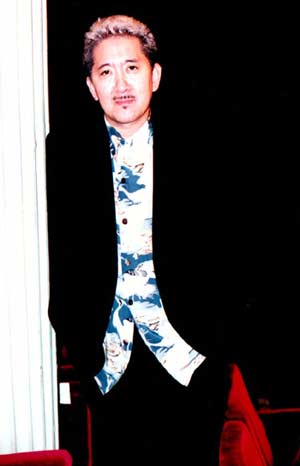
 AsianConnections
Arts & Entertainment Editor Lia Chang (left) currently appears as
Nurse Chang on As The World Turns and One Life to Live.
She is an accomplished stage, screen and TV actress, photographer
and writer based in New York City. AsianConnections wishes to thank
Lia and Philip Kan Gotanda for their generous time and efforts in
making this interview possible.
AsianConnections
Arts & Entertainment Editor Lia Chang (left) currently appears as
Nurse Chang on As The World Turns and One Life to Live.
She is an accomplished stage, screen and TV actress, photographer
and writer based in New York City. AsianConnections wishes to thank
Lia and Philip Kan Gotanda for their generous time and efforts in
making this interview possible.  |
|||
|
 |
|
|
| | About Us | Disclaimers and Legal Information | Advertise With Us | We welcome your comments. Send e-mail to us at info@asianconnections.com Copyright ©1999-2002 AsianConnections.com |